
Philosophy

At the heart of the Protus philosophy is “curious exploration”, i.e. the participants' inherent passion to explore questions about themselves and the world. In order to achieve rewarding results from this drive, a number of aspects need to be considered. Two of these aspects are emotional safety and acceptance, which we believe are fundamental to creating a comfortable environment for personal growth and “curious exploration”. Another aspect is critical thinking, which should be seen here as a legitimate use of reason to explore a topic.
Protus is a philosophy-of-life association that is first and foremost for the campers and members, but we also serve society. By not taking a position on political, philosophical or religious issues, we are for all people. However, we have certain values and views that we uphold in our activities. Protus does not say what people should think, but that and how they should think, namely critically and with an open mind. Protus does not offer simple answers, but only tools that people can use to find their own answers.

Protus is an association that wants to help individuals grow as a person. This is much more than just a physical process that makes the body grow. It is also an intellectual, emotional and social process and it is these three aspects of human development that Protus cares about.
Protus' methodology for finding one's own place in the world and formulating one's own philosophy of life hopefully makes one grow intellectually, but our methodology aims for people to develop emotionally and socially as well, to the same extent if not more. Enjoyment, fun and friendship are always at the heart of what we do. Protus affirms the whole person, as a thinking as well as a feeling being.
There is a lot of talk and discussion at the camp, both organized and spontaneous, about important and unimportant things. Being able to talk and being properly listened to, have a voice and really understand what someone else is saying is one of the things that many of the participants appreciate most about the Protus camp.
PRINCIPLES
In order for the association to be effective, amicable and to fulfill its function, there are certain principles that must be maintained within it. As Protus is essentially non-partisan, it does not require its members to practice these principles outside the association, but they must be observed within the association and during its activities, as they are a prerequisite for Protus functioning.
Compassion:
Being compassionate means treating other people well, out of concern and not just as a means to an end.
Critical thinking:
Thinking critically is a prerequisite for fruitful discussions. It means questioning what others say, but in a constructive and respectful way, i.e. listening to what other people say and taking the time to evaluate how reasonable it seems.
Interpret in a positive way:
Always assume that your conversation partner has a positive intent and try to help them formulate their thought in the best possible way rather than intentionally misinterpret it and using it as a stepping stone for your own argument
Democracy:
Protus is a democratic association, which means that all members have the right to decide on the association together.
A Development path
The purpose of the camps is to offer a fantastic and fun experience in a natural environment together with other people and to offer the opportunity to reflect on life's big questions and get the chance to start formulating your own philosophy of life.
Each day of a Protus camp has a specific theme. The idea is that all the exercises on that day will give the participants the opportunity to reflect on that particular theme.
This experience can be reinforced by additional elements such as adapted food, appropriate choice of wake-up music, etc. The theme days are also arranged in a certain order and form a "common theme" that allows for linking discussions from one day to the next and providing deeper thoughts and insights.
In the first part of the camp, we explore how the world and we humans work. In the second part, we explore how each of us thinks the world and ourselves should be. This summer will be the first time that we hold a version of the camp in this format, so the precise layout of each day is still in the works, but a potential daily schedule for a six day camp could be:

Day 1: Arrival day. On the arrival day, the focus is on making everyone feel welcome and quickly establishing a good basic atmosphere in the participant group. All participants are included and a high level of tolerance is created. We set the framework for this particular camp and go through the set rules Protus has. The participants can also decide on certain rules and attitudes that will apply to their particular camp.
Day 2: Nature/Human.The morning is dedicated to nature. The exercises therefore revolve around experiencing nature around the campsite, testing various senses and talking about the physical world that surrounds us.
In the afternoon, we first do exercises that illustrate human beings as "animals"; how do our bodies work and how do emotions and needs arise? We then continue with our thoughts, our awareness or, if you like, our soul. “In what way are we animals?” “In what way are we different?”

Day 3: Life and development through it. Everything we know and think about the world and ourselves. This day is designed to build on the thoughts of the previous days to highlight how we change over time. Discussion topics on this day include: "What circumstances from my birth to now make me who I am?" and "What does my future reality look like and how do I think about it?".
Day 4: Love and relationships. However, life, as discussed on Day 3, is not only about me, but also about the people I live among: parents, relatives, teachers, friends and "adults". This day is about the relationships we have and how we deal with them. Especially about being in love and how to nurture such a relationship.
Day 5: Civilisation. The whole world is interconnected through relationships between people; together they form what can be called human civilization. In previous days, we have focused on nature, ourselves and everyone around us, but today we are broadening our perspective to include society. For example, we play games that illustrate how people form and govern their societies.
We also move further from the description of how the world is into how we individually think the world ought to be. “What is a good way to organize humanity?” “Is a well functioning dictatorship better than a chaotic democracy?”
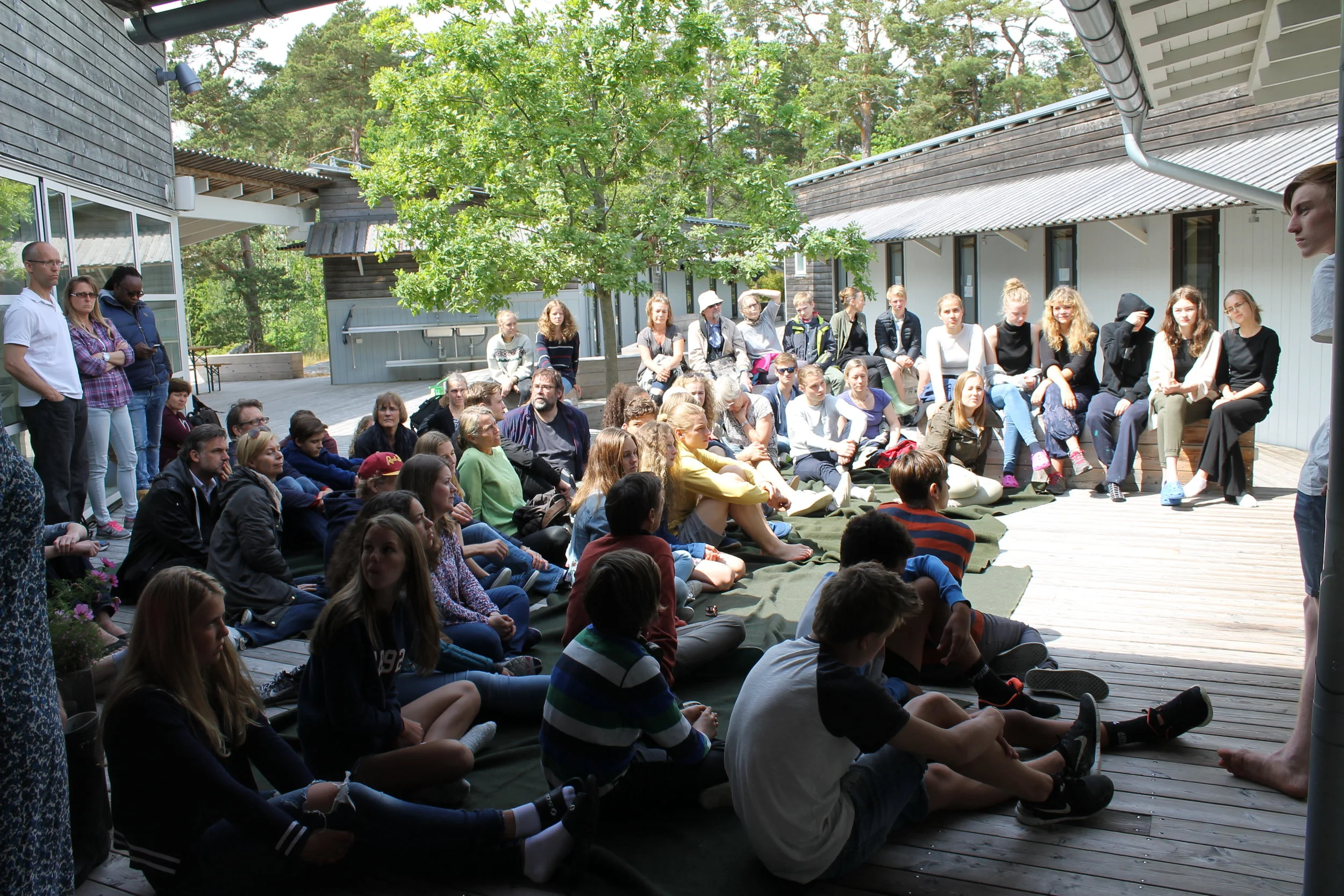
Day 6: Morality and closure. Having spent the first part of the camp discussing how things are and what we actually do: nature, people, relationships, society, we now move on to consider whether any of this can be influenced. How I/we/society should be and how we should behave and live. What we call ethics and morality. Here the participants face moral dilemmas that are discussed and hopefully they get help in balancing their inner moral compass according to their own beliefs.
We also summarize the camp and reflect on how the things we have discussed here are applicable to our lives at home. What makes that life really worth living? How can I apply what I have developed here in my regular daily life?
We pack our things, clean up the island to leave it a little bit better than when we arrived and board the boat back to the city for tearfilled but happy goodbyes from our new friends
The pedagogical structure
In order for everyone - both participants and leaders - to have an amazing camp experience Protus has worked out a pedagogical structure to be followed on each camp. It is the responsibility of the team to make sure the structure is followed. With the help of this structure we hope all participants get to feel that the camp has given them something meaningful for life. The core of the pedagogical structure is that the camp has three layers, or levels, that are more or less accessible for the participants to discover and explore. The levels are as follows:
1. Sense of community, swimming, games, and nature
This is the surface level of the camp. Everyone can join in on this level. Here the participants are given memories for life and an experience above the ordinary when it comes to friendship, nature, and leisure activities. This has a multitude of functions, such as to strengthen the bond between participants and leaders, to give energy for activities and exercises and also to offer a change of scene and rewarding experiences to participants who might not be mature enough for the later levels. The games - which involves everything from tag to dancing - are both easy going recreation and relaxing meditation.
2. Exercises and discussions
For the majority of the participants the exercises, discussions and curious exploration give new insights on how to approach the larger questions of life. This is the main point of a Protus camp. This is the level that the participant can bring with them and have use of for a long time.
The exercises are scheduled activities which in different ways relate to the theme of the day. These activities are meant to give the participants the opportunity to examine questions and subjects which are relevant to the primary purpose of the camp - letting young people begin to formulate their own view of life.
3. Context
This is the deepest level of the camp. The days and exercises create a whole that perhaps not all participants, or even leaders, perceive. On this level the participant begins to build a coherent and reflected worldview, with their own understanding of answers to different philosophical questions. This level is made up by the themes of each day at camp and their given order. This order is made to be a consistent way towards a view of life. We start off with how the world looks - from the outside world to the world inside ourselves - we then move on towards questions about how the participants think the world and their own lives should be. Towards the end of camp all of this is put in relation with the individual and the participants are given the opportunity to look inward and try to understand their own place in the world. In conclusion, the camp is divided into three questions: how does the world work? How do I think it should work? And on this basis, how should I act in my life? This level does not need to be explained to the participants. It should be in the background and represented in the order of the themed days.
The myth of Prometheus - Protus “forefather” and inspiration
According to Greek mythology, Prometheus was a so-called Titan, one of the original gods. Together Prometheus and Zeus formed the first humans from clay and made them walk upright. Zeus gave the humans the spark of life, but at the same time he was frightened that they would evolve and start competing with him for power. He thought the humans should stay primitive, and use their wooden bows and knives made from bones to hunt their food.
Prometheus on the other hand had come to love the humans and he said to Zeus: “We have to give them our fire too. Otherwise they are as helpless as children. We have to finish what we started.”
When Zeus disagreed, Prometheus went to Olympus alone and in secret. There, the fires burned day and night. He lit a torch and gave it to the humans. With the help of this first fire, the humans made more fires and Prometheus taught them how to best use the fire. With the help of Prometheus, the humans evolved quickly and could better form their own destiny.
The fire is a symbol of reason and with reason the human world started its long journey that has taken us to modern society. But, as symbolized in the myth by the box of Pandora, with the gift of reason also came immense power, struggle and war; and many other unspecified evils which were then released into the world.
The Promethean question remains: How can we humans use our reason; our ability to reflect on ourselves and our actions; and our moral compass, to make good use of our unique gifts as humans?